Understanding OB Care
Your Guide to a Healthy Pregnancy
Finding out that you are pregnant is a big moment. Whether it is your first pregnancy or not, you probably have a lot of questions. What happens now? Who do I see? What do these appointments involve?
OB care (short for obstetric care) is the medical care you receive during pregnancy, labor, delivery, and after birth. It is one of the most important things you can do to protect your health and your baby's health.
This guide will explain what OB care is, why it matters, and what to expect at every stage of your pregnancy. At Neighborhood Health Center (NHC), we are here to walk with you every step of the way.
What Is OB Care?
OB care stands for obstetric care. It is the healthcare you receive during and after pregnancy. An obstetrician (often called an OB or OB-GYN) is a doctor who specializes in pregnancy, childbirth, and recovery after birth.
OB care includes:
- Regular prenatal visits (checkups during pregnancy)
- Screenings and tests to check on you and your baby
- Support during labor and delivery
- Care after birth for both you and your newborn
Who Provides OB Care?
You do not have to see an OB-GYN specifically to get good prenatal care. Several types of providers are trained to support you during pregnancy.
Provider Type |
What They Do |
| Family Medicine Provider | Can provide prenatal care for average-risk pregnancies. This is NHC's approach. Your family medicine provider cares for you from early pregnancy all the way through postpartum and can continue caring for you and your newborn well beyond that, building a long-term relationship with your whole family. |
| OB-GYN | Doctors who specialize in women's health. Many people get prenatal care from an OB-GYN. |
| Maternal-Fetal Medicine (MFM) Specialist | OB-GYNs with extra training in high-risk pregnancies. You may be referred to one if complications develop. |
| Certified Nurse-Midwife (CNM) | Nurses with special training in pregnancy care. They provide care for average-risk pregnancies from early pregnancy through labor, delivery, and the postpartum period. |
What matters most is that you start care early and keep your appointments. If you are not sure where to start, your NHC provider can help.

Why OB Care Matters
Getting early and regular prenatal care is one of the best things you can do for yourself and your baby. Regular prenatal care helps your provider find problems sooner and take steps to manage them.
Here is why it matters so much:
It Helps Catch Problems Early
Many health problems during pregnancy (like high blood pressure, gestational diabetes, or anemia) do not always cause symptoms right away. Regular prenatal visits help your provider find and manage these issues before they become serious. Early detection and management are key to reducing the risk of preterm birth, low birth weight, and other complications.
It Tracks Your Baby's Growth
Prenatal care includes ultrasounds, blood tests, and screenings to monitor how your baby is growing. These tests can catch potential issues, like birth defects or growth concerns, early enough to prepare and plan.
It Keeps Medications Safe
Some medications (including certain over-the-counter products, herbal supplements, and acne treatments) can harm a developing baby. Your provider can help you know what is safe to take during pregnancy. Never stop or start any medication without talking to your provider first.
It Supports Healthy Habits
Prenatal visits are a great time to talk about eating well, staying active, and avoiding things that can harm your baby, like smoking, alcohol, and drugs. Your provider can guide you on what vitamins and nutrients your body needs.
It Connects You to Support
Your provider may ask about your support network, your ability to buy healthy food, and your ability to get to appointments. These things can all affect your health during pregnancy. If you need help with any of them, like transportation or food access, let your provider know. NHC can help connect you with community resources.
It Supports Your Mental Health
Pregnancy is not just a physical journey. It is an emotional one, too. Your provider can screen for depression, anxiety, and stress at prenatal visits. Taking care of your mental health is just as important as taking care of your body.
Prenatal care also helps protect your baby. Smoking and drinking alcohol during pregnancy raise the risk of Sudden Infant Death Syndrome (SIDS). Alcohol use can also cause fetal alcohol spectrum disorders, which can affect your baby's brain, heart, kidneys, and development. There is no known safe amount of alcohol during pregnancy.
According to NICHD, taking 400 micrograms of folic acid every day (before and during early pregnancy) can reduce the risk of serious birth defects of the brain and spine by up to 70%. Most prenatal vitamins include the recommended amount of folic acid.

Before You Get Pregnant: Pre-Pregnancy Care
If you are thinking about becoming pregnant, there are steps you can take now to give your baby the best start. This is called pre-pregnancy care or preconception care.
Before getting pregnant, you can:
- Start taking folic acid (at least 400 micrograms a day)
- Make sure your vaccines are up to date
- Talk to your provider about any health conditions you have, like diabetes or high blood pressure
- Stop smoking, drinking alcohol, and using drugs
- Work toward a healthy weight
- Share your family health history with your provider
- Get support for depression, anxiety, or other mental health concerns
You do not have to have everything figured out before your first visit. Just reaching out is the right first step.
How Often Will I Have Prenatal Visits?
Your visit schedule will depend on your health and any risks. In general, most people follow a schedule like this:
Stage of Pregnancy |
How Often |
| Weeks 4–28 (First & early Second Trimester) | Once a month |
| Weeks 28–36 (Late Second & early Third Trimester) | Every 2 weeks |
| Weeks 36–41 (Late Third Trimester) | Once a week |
What Is Tailored Prenatal Care?
Every pregnancy is different. Your OB provider may customize your care plan based on your health needs and risk level. This is called tailored prenatal care.
For example, some routine check-ins may be done by telehealth (a video or phone visit) when no physical exam or lab test is needed. In-person visits are still needed for things like ultrasounds, blood draws, and physical exams.
Talk with your provider about what kind of schedule makes sense for you.
If you have health concerns or a higher-risk pregnancy, your provider may want to see you more often. Your partner or a support person is always welcome to come to your appointments.
What Happens at Your First Prenatal Visit?
Your first prenatal visit is usually the longest. This is when your care team gets to know you and your health history. Try to schedule this visit as soon as you know you are pregnant, ideally in the first 6 to 12 weeks.
What to Bring to Your First Visit
Coming prepared will help your provider give you the best care. Try to bring:
- The first day of your last menstrual period (helps establish your due date)
- A list of all medications, vitamins, and supplements you are taking
- Information about any health conditions you have, past surgeries, and your vaccination records
- Information about past pregnancies, including any miscarriages, stillbirths, or abortions
- Any history of preterm delivery, preeclampsia, or gestational diabetes
Do not worry if you do not have everything. Your provider can help fill in the gaps.
At your first visit, your provider will likely:
- Review your medical history, current health conditions, and any medications you take
- Ask about your family health history and your partner's health history
- Do a physical exam, including blood pressure, weight, and a pelvic exam
- Collect blood and urine samples to check for infections, blood type, anemia, and other conditions
- Confirm your pregnancy and give you an estimated due date
- Prescribe a prenatal vitamin with folic acid
- Discuss what to expect in the coming months
- Ask about your support network, access to food, ability to get to appointments, and connect you with help if needed
Everything you share with your provider is private. Do not be afraid to be honest, even about things that feel uncomfortable. Your provider needs the full picture to give you the best care.
Related: Exercise During Pregnancy — What is Safe, What to Skip, and Why it Matters

What Happens During Pregnancy: The Four Trimesters
Pregnancy is divided into four stages: three trimesters and a fourth stage called postpartum. Each one brings different changes and different things your provider will watch for.
First Trimester: Weeks 1–13 (through 13 weeks, 6 days)
The first trimester is when most of your baby's body systems begin to form. This is also when your baby is most vulnerable.
Your OB provider will focus on:
- Making sure you are getting the right nutrients and vitamins
- Guiding you on what to avoid, like certain foods, medications, and substances
- Checking your overall health and any pre-existing conditions
- Helping you manage early pregnancy symptoms like nausea
- Confirming your due date often with an early ultrasound
- Ordering bloodwork and STI screenings to check for infections that can affect your baby
If you have a health condition like diabetes or high blood pressure, managing it early in pregnancy is especially important.
Second Trimester: Weeks 14–27
Many people feel better in the second trimester. Your baby is growing fast, and your provider will start tracking that growth more closely.
During this stage, your provider will:
- Check your baby's heartbeat at every visit
- Measure your belly to track your baby's growth
- Do a detailed ultrasound at around 18–20 weeks to check on your baby's development
- Test for gestational diabetes and anemia between weeks 24–28
- Offer optional genetic screening tests
- Talk with you about signs of preterm labor to watch for
Visits happen every four weeks until you reach 24-26 weeks gestational age; then they happen every two weeks. You may be able to find out your baby's sex at the 20-week ultrasound. Let your provider know if you would rather wait!
Third Trimester: Weeks 28–Birth
In the third trimester, visits become more frequent. Your provider is closely monitoring you and your baby to make sure both of you are ready for delivery.
During this stage, your provider will:
- Check your baby's position. Most babies move head-down before birth. If yours is in a different position (called breech), your provider will talk with you about your options.
- Screen for group B strep bacteria around weeks 35–37. If you test positive, antibiotics during labor can protect your baby.
- Discuss signs of labor and when to go to the hospital
- Talk about your birth preferences, things like pain management or who you want in the room
- Give you a Tdap vaccine (whooping cough) to protect you and your newborn
What About Labor and Delivery?
When it is time to have your baby, you will be in good hands, even though your NHC provider will not be in the delivery room with you. At NHC, we work closely with trusted community partners who will care for you during labor and delivery.
Where you deliver depends on which NHC clinic you receive care at:
- Tanasbourne patients deliver with OHSU Family Medicine at Hillsboro Medical Center
- Oregon City patients deliver with Women's Healthcare Associates at Providence Willamette Falls Medical Center
Your NHC care team will help you understand what to expect, connect you with your delivery team, and make sure you feel prepared and supported before that day comes. After delivery, your NHC provider will continue to care for you through postpartum.
Fourth Trimester: Postpartum (Birth through 12 Weeks)
The postpartum period (sometimes called the fourth trimester) begins right after your baby is born and lasts about 12 weeks. This stage is just as important as the three that came before it. Your body is healing, your hormones are shifting, and you are adjusting to life with a new baby.
What Your Body Is Going Through
According to the Mayo Clinic, after delivery, it is normal to experience:
- Vaginal soreness or pain, especially if you had a tear or an episiotomy (a small cut made during delivery to help the baby out). This can take a few weeks to heal.
- Vaginal discharge, called lochia. It starts bright red and heavy, then gradually becomes lighter in color and slows over 4 to 6 weeks. Contact your provider if you are soaking a pad every hour for two hours in a row.
- Cramping or afterpains as your uterus returns to its normal size. This is common, especially during breastfeeding.
- Breast soreness or engorgement. Your breasts may feel full, firm, and tender as your milk comes in. Breastfeeding, often on both sides, can help.
- Bladder leaking when you sneeze, laugh, or cough. This is common after delivery. Kegel exercises can help strengthen your pelvic floor muscles over time.
- Hair loss and skin changes. These are normal and will improve over time.
Your Mental and Emotional Health
Many new parents feel a mix of joy, exhaustion, and sadness after birth. Feeling tearful, anxious, or moody in the first week or two is common (sometimes called the baby blues). These feelings usually go away on their own within two weeks.
But if feelings of sadness, worry, or hopelessness last longer than two weeks — or if you are having trouble caring for yourself or your baby — that is a sign to reach out for help. Postpartum depression is a real medical condition, and it is treatable. You do not have to push through it alone.
Your Postpartum Checkups
OB care does not stop when your baby arrives. ACOG now recommends that postpartum care be an ongoing process. Here is what that looks like:
- Within 3 weeks of birth: Check in with your provider by phone or in person
- Throughout the postpartum period: Additional visits as needed
- By 12 weeks after birth: A complete postpartum checkup
At NHC, your provider will follow up with you to make sure you are healing and doing well. Postpartum care typically includes checking on your physical recovery, talking about any bleeding or healing concerns, screening for postpartum depression and anxiety, discussing birth control options, and answering questions about breastfeeding, sleep, and caring for yourself and your baby.
Almost 40% of new mothers miss their postpartum checkup. Even if you feel fine, please go. How you feel after birth matters just as much as how you felt during pregnancy.
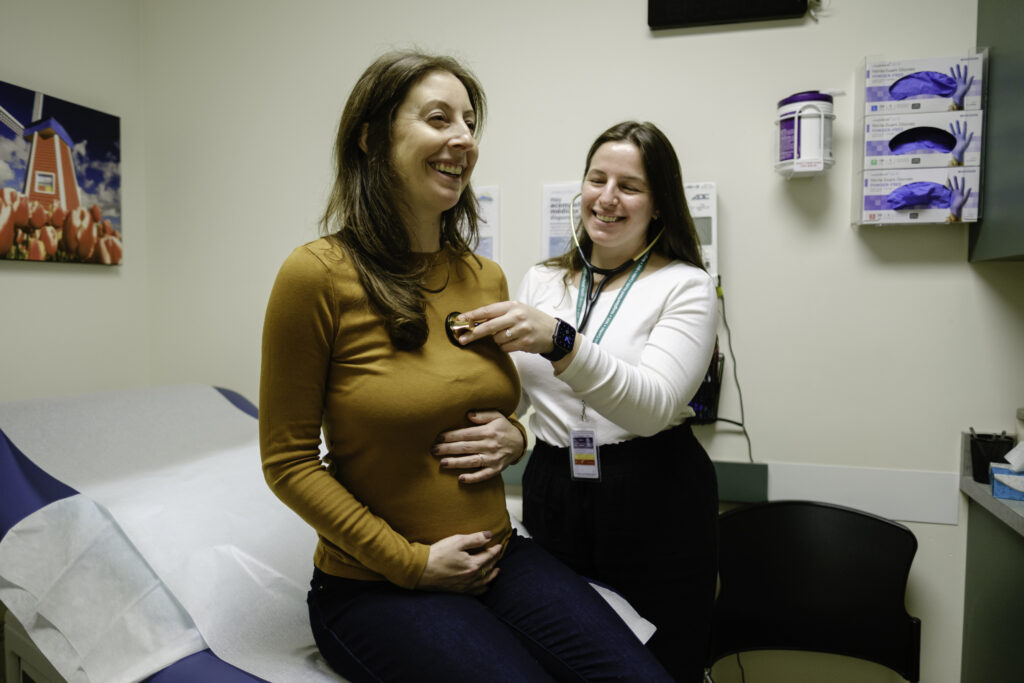
OB Care at Neighborhood Health Center
Every pregnancy is different. You do not have to navigate it alone. At NHC, our Family Medicine providers offer personalized, whole-person OB care that supports you and your baby from early pregnancy through postpartum.
OB care is currently available at two NHC locations:
What NHC OB Care Includes
Your NHC care team will support you throughout your pregnancy with care centered on you, your needs, and your goals. Services include:
- Routine prenatal care for low and moderate-risk pregnancies
- Nutrition and wellness support
- Lactation education
- Birth planning
- Postpartum care
- Behavioral health support
- Well baby care
- Vaccinations
- Routine blood work
- Postpartum contraception
- Referrals for ultrasounds and advanced prenatal testing
Delivery Care
Your NHC provider will care for you during your pregnancy, help you plan for delivery, and support you and your family after birth. NHC works closely with trusted community partners to make sure you and your baby have the care you need during delivery.
Tanasbourne Patients
Deliver with OHSU Family Medicine at Hillsboro Medical Center
Oregon City Patients
Your care team will guide you through your options and help you coordinate your care so you feel prepared and supported.
Why Choose a Family Medicine Provider for OB Care?
NHC uses a Family Medicine approach to prenatal care. This means your care is personal, connected, and centered on you and your family. You build (or continue) a long-term relationship with a provider who already knows your health history and your needs.
With NHC's approach, you get:
- Continuity of care: the same provider for prenatal visits and postpartum care
- Whole-person support: care for pregnancy, chronic conditions, and mental health together
- Personalized care: with a team that understands your preferences and challenges
- Care for your whole family: seamless support for your baby, your partner, and your family after birth
Language Access and Financial Assistance
Our teams speak English and Spanish, and interpreter services are available for other languages. No one should go without care because of language barriers.
No insurance? No problem. NHC offers discounts on all services and prescription medications based on income. All patients are encouraged to apply. We are here for everyone — regardless of insurance status.
Ready to Get Started?
No matter where you are in your pregnancy, NHC is here to support you.
NHC provides comprehensive care for patients of all ages, including prenatal, primary care, dental, and behavioral health services.
This article is for informational purposes only and is not a substitute for professional medical advice, diagnosis, or treatment. Please talk with your healthcare provider for personalized health advice.
Sources
- American College of Obstetricians and Gynecologists (ACOG). Prenatal Care FAQs. acog.org/womens-health/faqs/prenatal-care
- UNC Medical Center. Obstetric Care. uncmedicalcenter.org/uncmc/care-treatment/womens-health/pregnancy-birth-care/obstetric-care/
- Wooster Community Hospital. Obstetrician Care During the 3 Stages of Pregnancy. woosterhospital.org/obstetrician-care-during-the-3-stages-of-pregnancy/
- March of Dimes. Prenatal Care Checkups. marchofdimes.org/find-support/topics/planning-baby/prenatal-care-checkups
- UnityPoint Health. The Ultimate Pregnancy Appointment Guide: What to Expect Week by Week at Your Prenatal Visits. unitypoint.org
- National Institute of Child Health and Human Development (NICHD). What Is Prenatal Care and Why Is It Important? nichd.nih.gov/health/topics/pregnancy/conditioninfo/prenatal-care
- National Institute of Child Health and Human Development (NICHD). Pre-Pregnancy Care and Prenatal Care. nichd.nih.gov/health/topics/preconceptioncare
- Health Partnership Clinic. The Importance of Prenatal Care: A Key to a Healthy Pregnancy and Baby. hpcks.org/the-importance-of-prenatal-care-a-key-to-healthy-pregnancy-and-baby/
- Neighborhood Health Center. Obstetric Care. nhcoregon.org
- American College of Obstetricians and Gynecologists (ACOG). What to Expect at a Postpartum Checkup — And Why the Visit Matters. acog.org/womens-health/experts-and-stories/the-latest/what-to-expect-at-a-postpartum-checkup-and-why-the-visit-matters
- March of Dimes. Your Postpartum Checkups. marchofdimes.org/find-support/topics/postpartum/your-postpartum-checkups
- Lopez-Gonzalez DM, Mikes BA. Postpartum Care of the New Mother. StatPearls. ncbi.nlm.nih.gov/books/NBK565875/
- Mayo Clinic. Postpartum Care: What to Expect After a Vaginal Birth. mayoclinic.org/healthy-lifestyle/labor-and-delivery/in-depth/postpartum-care/art-20047233

Kristin Bendert, Family Physician at NHC Oregon City Medical Clinic
This article was reviewed by Kristin Bendert, MD, a Family Physician at NHC Oregon City Medical Clinic. Dr. Bendert earned her Doctor of Medicine and Master of Public Health from Saint Louis University and her Bachelor of Arts from Augustana College. She completed her Family Medicine Residency at Oregon Health & Science University (OHSU), with a special emphasis on maternal and child health. She brings over 10 years of experience in family medicine with obstetrics and primary care. At NHC, she provides care to patients of all ages, from newborns to geriatrics, with special interests in women's health, chronic disease management, and lifestyle medicine.